Phonak Audéo Infinio Sphere I90 vs. Fortell
My Real-World Hearing Aid Review
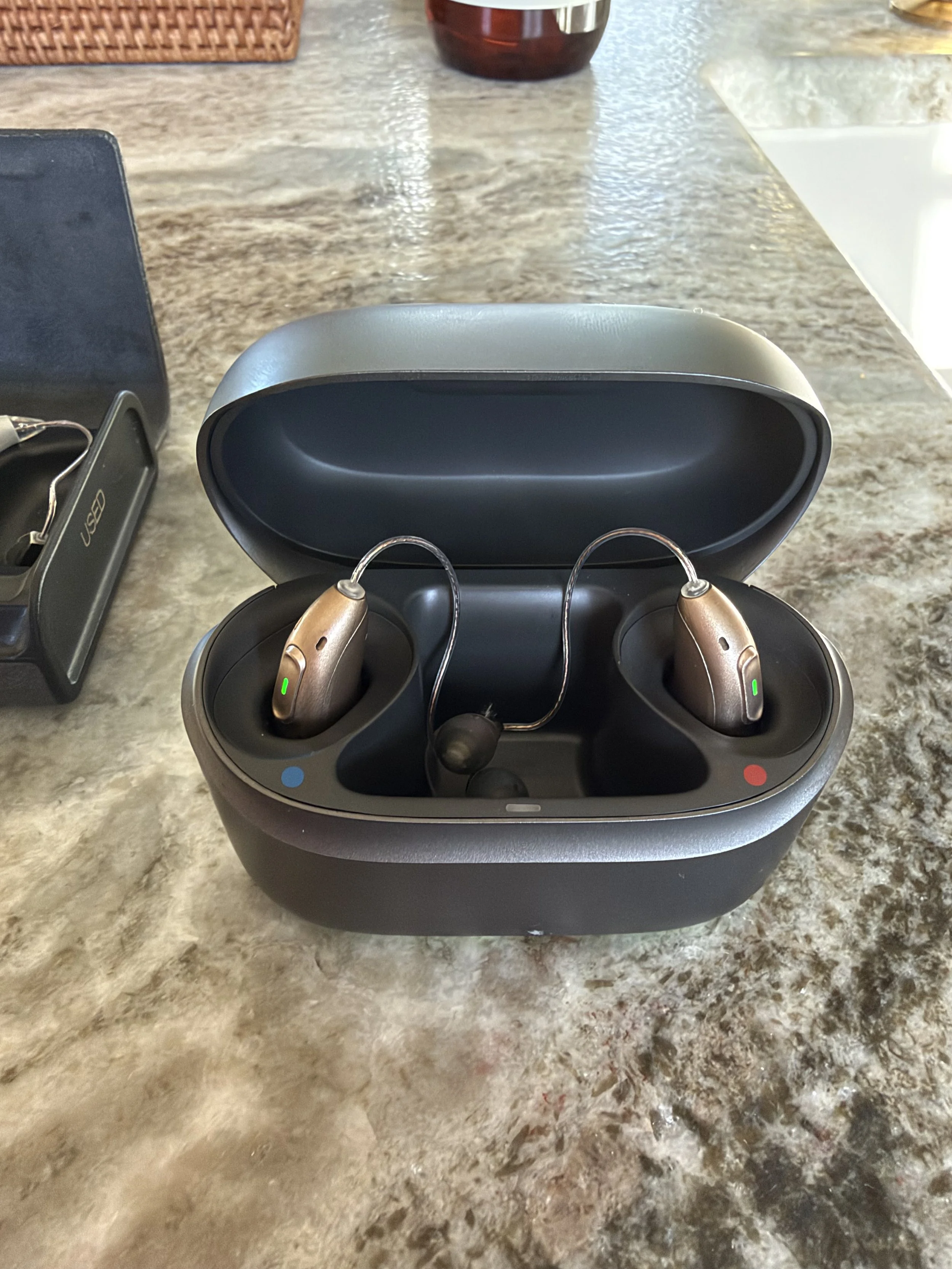
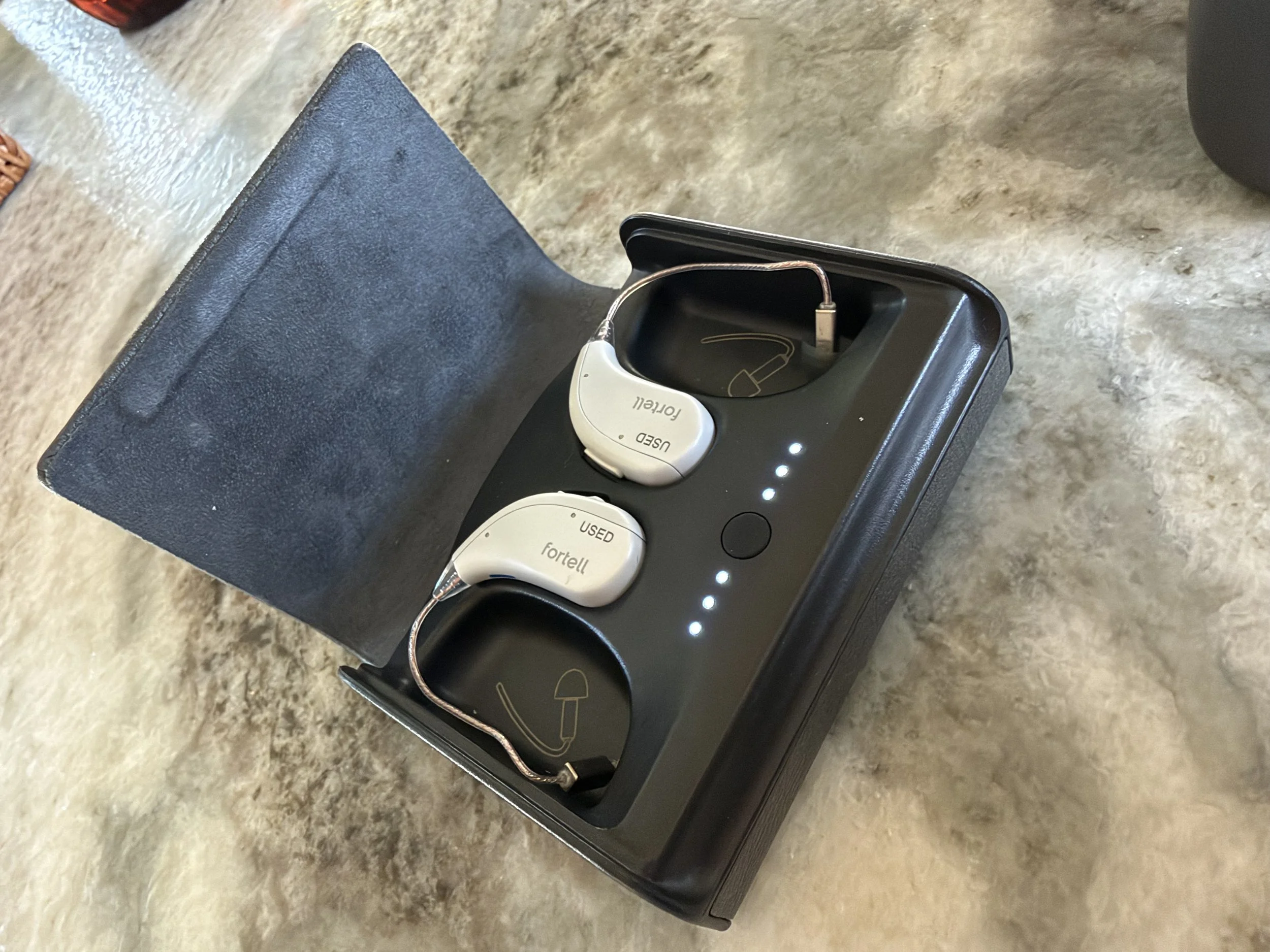
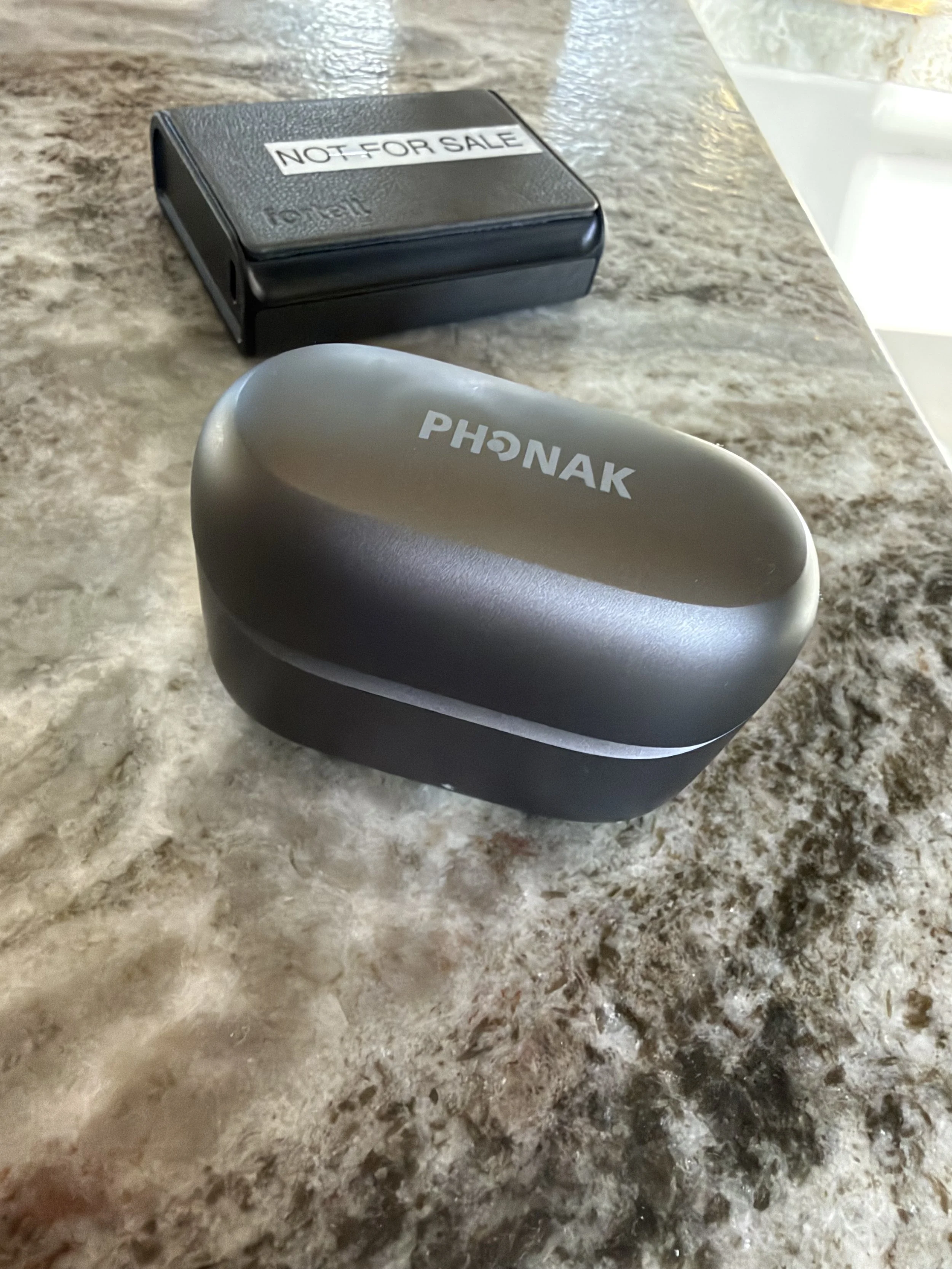
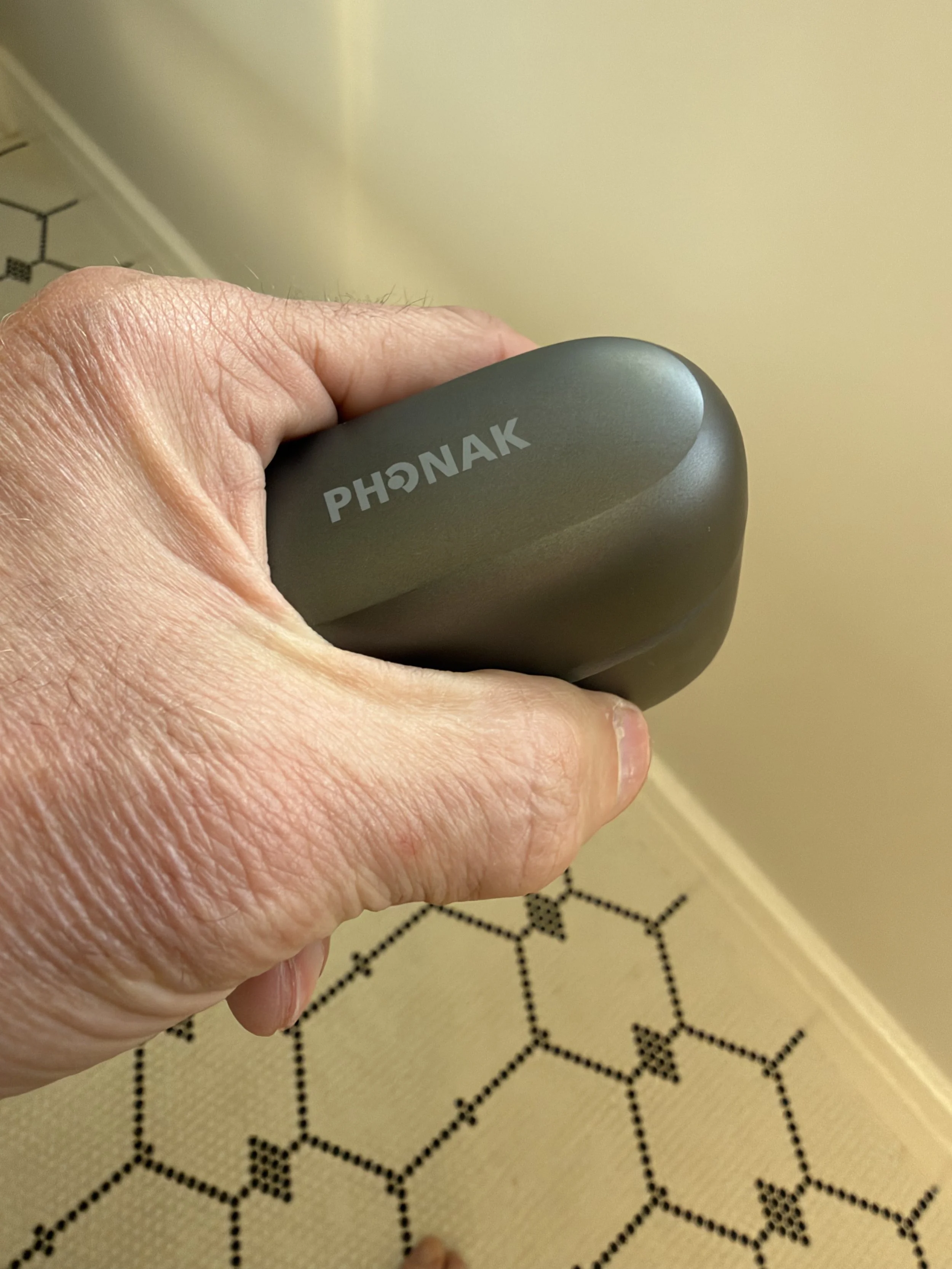
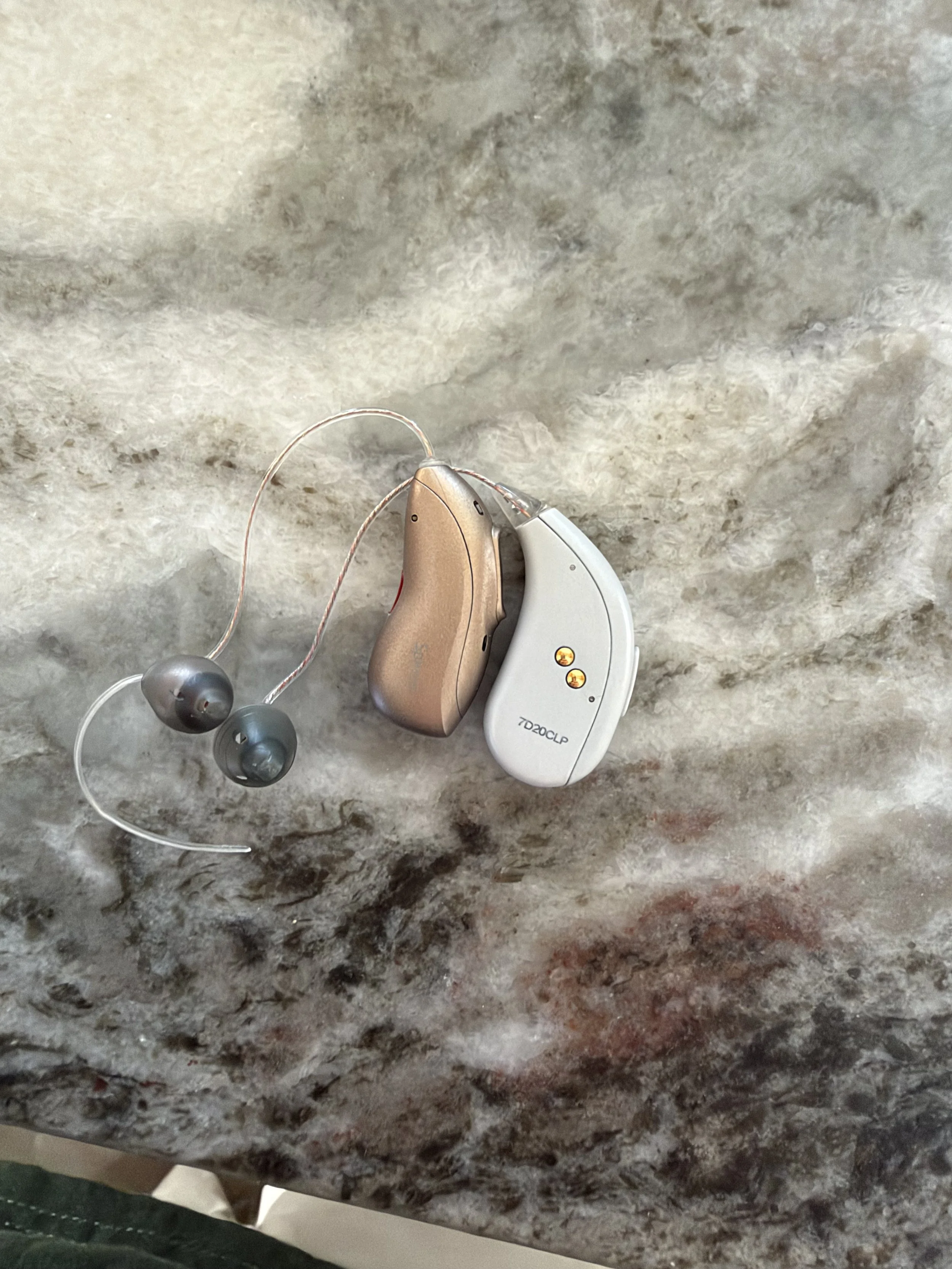
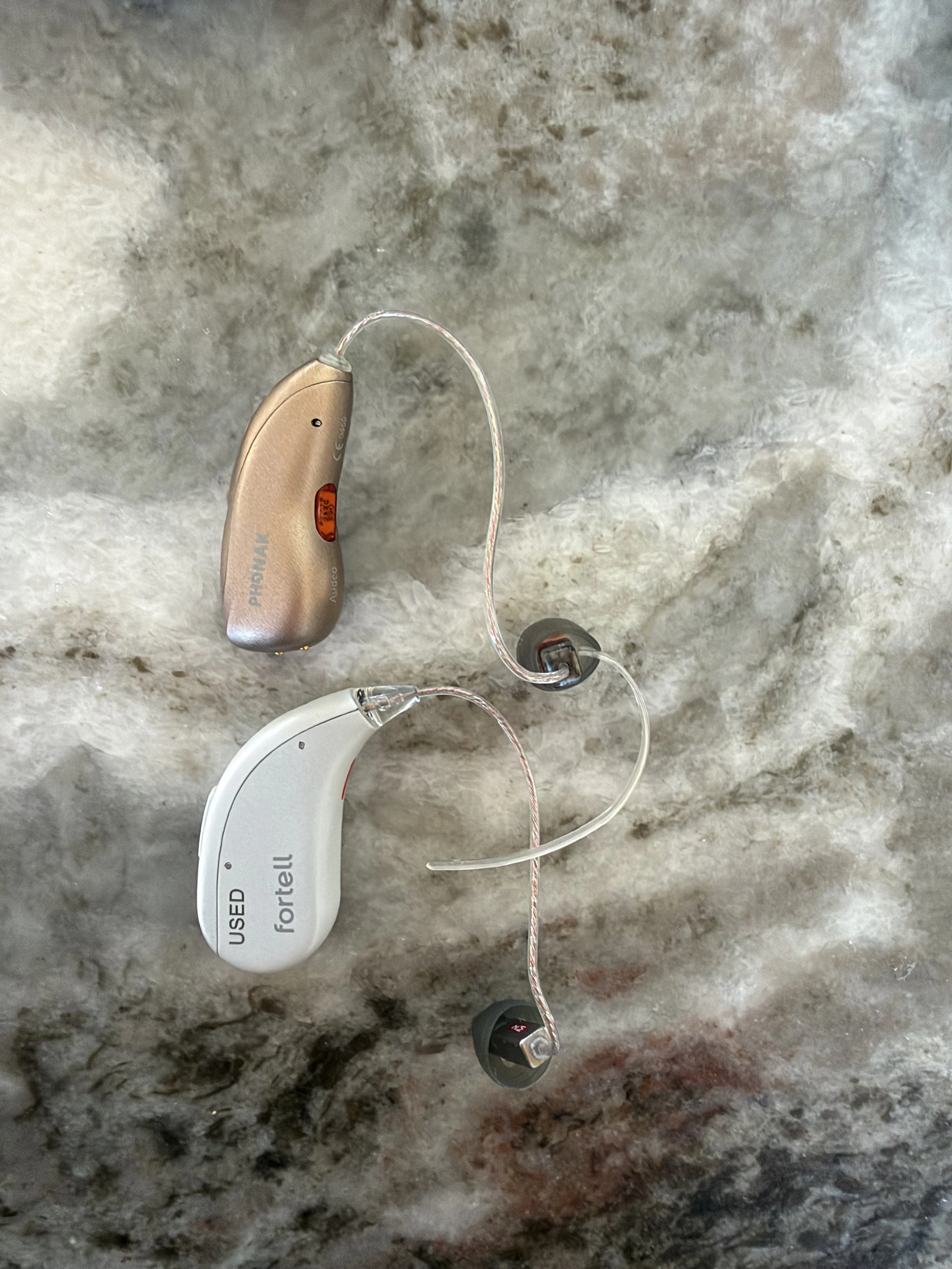
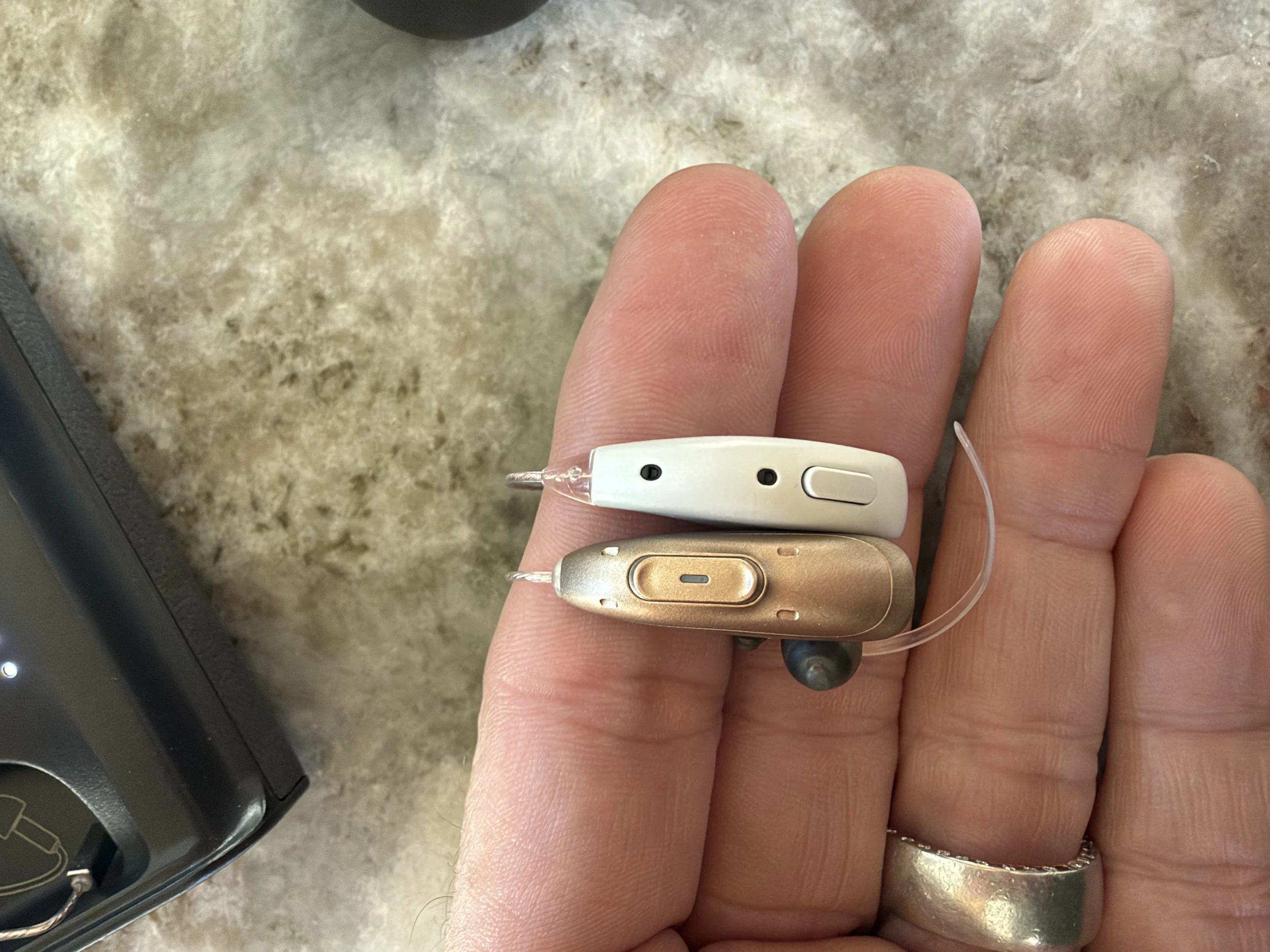
Phonak Audéo Infinio Sphere I90 vs. Fortell
My Real-World Hearing Aid Review
October 20 – November 20, 2026
One Month, Two Premium Hearing Aids, and One Clear Decision
After spending a month wearing the Phonak Audéo Infinio Sphere I90 hearing aids and approximately 11 days testing the Fortell hearing aids, I've made my decision.
I'm keeping the Phonaks and have returned the Fortells.
Both are premium hearing aids featuring advanced sound processing and artificial intelligence designed to improve speech understanding, particularly in challenging listening environments.
I wanted to compare them in everyday situations rather than rely entirely on specifications, marketing demonstrations, or online reviews.
My priorities were sound quality, clearer conversations, music, comfort, Bluetooth reliability, appearance, and overall value.
Fortunately, I had the opportunity to wear both pairs during the same period. This allowed me to switch between them and compare their performance in familiar situations.
This is my personal experience with both products, including what impressed me, what disappointed me, and why I ultimately chose Phonak.
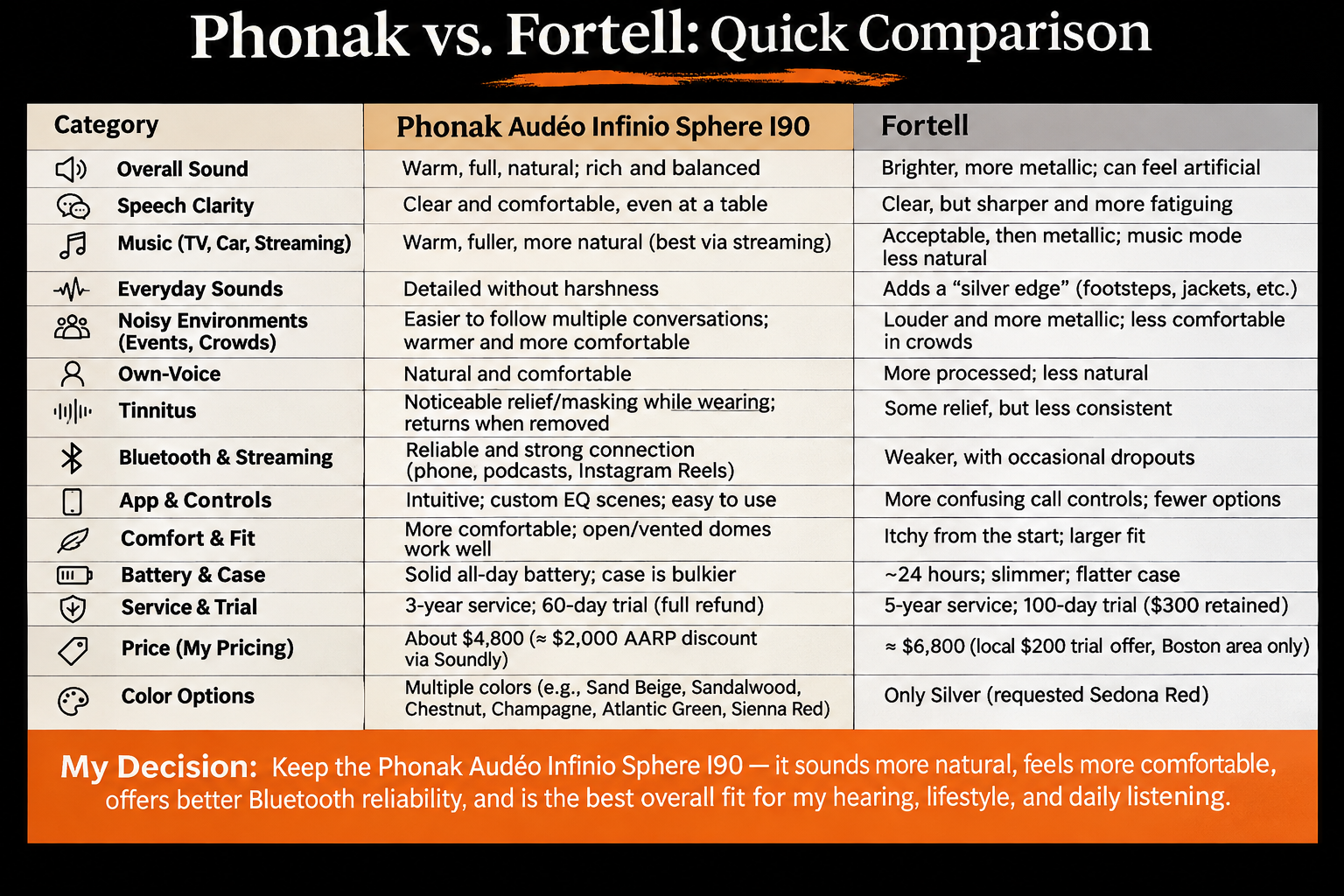
This comparison reflects my personal experience rather than laboratory testing. Battery figures are approximate.
My takeaway: Both hearing aids helped me understand conversations I would otherwise struggle to follow. But the Phonaks sounded more natural to me, were more comfortable, and offered better Bluetooth reliability, all at a substantially lower price.
My Hearing History: Music, Concerts, and Hearing Loss
I've lived with high-frequency hearing loss for more than 20 years, and genetics likely plays a significant role.
Music has always been a big part of my life.
When I was younger, I was very much into punk rock, alternative, and new wave music. I loved seeing local bands and going to concerts.
I remember leaving shows with my ears ringing, sometimes overnight, sometimes into the next day, and occasionally for several days.
Looking back, I suspect repeated exposure to loud music may have contributed to my hearing loss.
I also experience tinnitus. In one ear, it sounds like crickets. In the other, it's more like a summer evening filled with insects.
After decades of hearing loss, I sometimes wonder whether I even remember what natural hearing is supposed to sound like.
My First Experience with Hearing Aids
Around 2017, I tried Signia hearing aids, but I never really got accustomed to wearing them.
I found the sound tinny and artificial, and they weren't particularly comfortable either. As a result, I wore them only a handful of times before giving up on them.
At the time, I hadn't spent much time researching hearing aids on YouTube or learning about the technology, fitting adjustments, and the process of adapting to amplification.
Looking back, I realize I didn't give those hearing aids much of a chance, but I also didn't have the knowledge I have today.
This time, I approached the experience very differently. I spent considerable time educating myself, researching different hearing aids, and learning what to expect before making a decision.
Researching Hearing Aids Before Buying
Before purchasing hearing aids, I spent considerable time researching the latest technology on YouTube.
I watched reviews and discussions from Dr. Cliff Olson, Dr. Steve Taddei of Hearing Tracker, Treble Health, This Week in Hearing, and Soundly Hearing, the YouTube channel associated with Soundly.com.
I particularly enjoyed watching Blake Cadwell, a co-founder of Soundly who also wears hearing aids.
His video, 30 Days in Phonak Sphere Infinio: What I Learned, was especially helpful.
I appreciated hearing from someone who actually wears hearing aids and understands the challenges of hearing loss firsthand.
I also researched Fortell extensively.
Dr. Steve Taddei's independent review was particularly useful, although I found relatively few independent Fortell reviews compared with Phonak.
Much of the other information consisted of interviews with the company's co-founders and patient testimonials.
That made the opportunity to try Fortell myself especially valuable.
Understanding Brain Adaptation
One important thing I learned during my research was that hearing aids don't necessarily sound natural immediately.
When you've lived with hearing loss for decades, your brain becomes accustomed to receiving less sound information.
Restoring access to higher frequencies can initially make ordinary sounds seem unusually bright or metallic.
Over time, those sounds may become less noticeable as the brain adapts.
I experienced some of that adjustment with my Phonaks during the first month.
It also made me wonder whether I might eventually have become more accustomed to the Fortells if I'd worn them longer.
That possibility is worth acknowledging, even though my experience during the demonstration ultimately led me to choose Phonak.
My Phonak Fitting Experience
I received my Phonak Audéo Infinio Sphere I90 hearing aids on October 20, 2026, through Beverly/Cape Ann Audiology.
My audiologist, Kathlryn, has been helping me adjust the programming and find the right ear domes.
I've experimented with open, vented, and more closed domes.
The more closed options sometimes made my own voice sound plugged up or exaggerated, an effect known as occlusion.
Smaller vented domes have generally been more comfortable for me.
We've also adjusted the Automatic and Music programs.
The overall experience has improved considerably, although there are still some settings I'd like to refine.
A Little Like The Bionic Woman
One of the funniest things about wearing hearing aids again was suddenly picking up sounds I hadn't heard in years.
My pants swishing as I walked, reaching into my pocket, someone chewing, or even conversations across the street between people walking their dogs.
I felt a little like Jaime Sommers, played by Lindsay Wagner in the 1970s TV show The Bionic Woman, with her incredible bionic hearing!
It was amusing, but also a reminder of just how many everyday sounds I'd been missing.
Future Adjustments with Kathryn
As I continue getting used to my Phonaks, I'd like to work with Kathleen on gradually increasing the amplification through several adjustments, possibly bringing the settings closer to my prescribed hearing targets.
I'm curious whether, as my brain continues adapting, I'll become comfortable hearing more of the sounds I've been missing for so many years.
I'm interested to see how much further we can improve them.
Trying Fortell on Newbury Street in Boston
On November 9, I visited Fortell's brand-new office on Newbury Street in Boston's Back Bay neighborhood for a fitting and demonstration.
Because I live relatively close to Boston, I was offered a special two-week demonstration for $200.
This was a limited offer intended for people living in the Boston area, rather than a nationwide demonstration available to out-of-state customers.
I appreciated the opportunity to try the hearing aids without committing to a full purchase.
Corinne, my Fortell audiologist, performed real-ear measurements and made several adjustments.
My initial impression was that the sound was extremely tinny and metallic.
She adjusted the programming, reduced the amplification somewhat below the prescribed targets, and tried different domes.
We initially experimented with larger vented domes before switching to smaller ones.
Corinne also made a subsequent remote adjustment to lower the volume further.
Although the changes helped, I continued to notice an artificial quality to the sound.
Fortell's Beautiful New Office
One thing I particularly enjoyed was visiting Fortell's brand-new Boston office.
I happened to be there on its very first day of opening, and I was only the second patient.
The office was beautifully designed, with wonderful artwork and thoughtful amenities, including Saratoga spring water, coffee, espresso, and tea.
As an artist, I especially appreciated the art and overall atmosphere.
I also had the opportunity to meet Cole, one of Fortell's co-founders.
He was very nice, and we talked about my friend Paul, who already wears Fortell hearing aids.
It was a memorable visit, and I appreciated the hospitality and personal attention.
My Friend Paul's Experience with Fortell
Another reason I was interested in Fortell was that my friend Paul already wore them.
Paul has more substantial hearing loss than I do and had upgraded from older Oticon hearing aids.
He told me the Fortells were a significant improvement.
After approximately three months, he said the sound was still somewhat tinny or robotic, although he was getting used to it.
He even joked about sounding like a robot!
Paul has had several programming adjustments and was considering custom earmolds.
He's also enjoyed wearing his Fortells at Broadway performances and movie theaters.
Overall, he's happy with them.
His experience reinforced something important: two people can have very different reactions to the same hearing aids.
What works for Paul doesn't necessarily work for me.
Sound Quality: Gentle Shimmer vs. Glitter Bomb
Sound quality was the biggest difference between the two hearing aids.
The Phonaks had a fuller, more natural quality, with a slight shimmer in the higher frequencies that gradually softened as I became accustomed to wearing them.
The Fortells had a noticeably sharper, more metallic edge.
Everyday sounds, including footsteps, clothing, and voices, sometimes seemed exaggerated or artificially processed.
The Phonaks have a gentle shimmer. The Fortells sometimes felt like a glitter bomb.
That description captures the difference better than any technical specification I could offer.
When I switched back to the Phonaks, I often felt an immediate sense of relief.
I could simply listen without being so conscious of the hearing aids themselves.
Conversations, Trivia Night, and Friendsgiving
One of my main goals was to follow conversations more easily, especially when several people were talking.
At my regular Wednesday trivia night, I tested the Fortells around a table with friends.
Voices sometimes sounded louder and more metallic than I preferred.
When I switched back to the Phonaks, I found conversations more comfortable to follow.
Friendsgiving: A Revealing Test
One of the most revealing situations during my trial was a Friendsgiving gathering in a crowded kitchen.
There were several conversations happening at once, people moving around, and plenty of background noise. It was exactly the kind of environment where I've struggled with my hearing for years.
Normally, without hearing aids, I would have difficulty understanding someone talking right next to me in a room that loud. I might hear their voice, but following what they were actually saying would be a challenge.
With both the Phonaks and the Fortells, those nearby conversations were much clearer and easier to understand.
That was a significant improvement, and I don't want to overlook it.
I was able to participate in conversations that would ordinarily have been difficult for me.
What surprised me, however, was how loud the surrounding environment still seemed.
Both hearing aids feature sophisticated AI technology intended to help with speech understanding in noisy environments. Based on some of the demonstrations I'd watched, I had expected the background noise to become noticeably quieter.
I was imagining something a little closer to the active noise cancellation I experience with my Apple AirPods Pro.
Of course, hearing aids and noise-canceling earbuds are designed for different purposes. Hearing aids are intended to improve access to speech and other sounds, not simply silence the room.
It's entirely possible that the AI processing was helping me understand speech without producing an obvious reduction in the overall noise level.
But from my own listening experience, I couldn't confidently tell how much background noise either system was actually suppressing.
The kitchen still sounded busy and loud.
The important distinction is that both hearing aids improved my ability to understand nearby conversations, even though neither made the room itself seem noticeably quieter.
For me, that's both a success and an area where I had expected more.
I was genuinely pleased that I could follow conversations in a difficult environment. At the same time, I still hope to improve how comfortably I hear in crowded restaurants, kitchens, and other noisy spaces.
I'd particularly like to work with Kathryn on fine-tuning the Phonak Spheric speech-in-noise settings to see whether we can improve that experience further.
I also recognize that different dome styles may influence the results, although comfort and avoiding that plugged-up sensation remain important to me.
Music: An Important Part of My Decision
Music has always been important to me.
I enjoy listening through my home speakers, in the car, and at live concerts.
I particularly appreciate rich bass, depth, and a balanced sound.
The Phonaks generally performed better for my musical preferences.
However, the dedicated Phonak Music program still needs improvement.
Kathleen has already made adjustments, but I'm not entirely satisfied with it yet.
With the Fortells, I experimented with AI, Conventional, and Music modes.
Conventional sometimes sounded better than AI, but I still noticed artificial processing.
The Music program was especially disappointing.
At times, I experienced feedback, and some music had an almost Auto-Tune-like quality.
Music in the car could also become metallic.
Neither hearing aid reproduced music perfectly, but I preferred the Phonak listening experience.
I'm looking forward to continuing to refine its Music program.
Television, YouTube, Instagram Reels, and Podcasts
I regularly watch television and YouTube videos, but when it comes to streaming directly through my hearing aids, I mostly listen to Instagram Reels and podcasts.
These provided opportunities to compare voices, dialogue, and different accents.
I deliberately tested British, Australian, Irish, and other accents, along with whispered dialogue and people who spoke unclearly.
The Phonaks generally made voices easier to follow.
The Fortell AI program sometimes made dialogue sound muffled or processed, while Conventional mode occasionally improved it.
Streaming Directly Through the Hearing Aids
For everyday Bluetooth streaming, particularly Instagram Reels and podcasts, I preferred the Phonaks.
Voices sounded warmer and were easier for me to listen to over extended periods.
The Fortells sometimes sounded brighter and more artificial, which made listening less comfortable.
The difference was noticeable when switching between the two hearing aids.
One feature I'd really appreciate with either product is a proper equalizer for Bluetooth streaming.
I'd like to be able to adjust the bass, midrange, and treble specifically for streamed audio, rather than relying entirely on the hearing aids' programmed sound settings.
That would give me more control over the listening experience, particularly for music and spoken content.
A Mumble Is Still a Mumble
With both hearing aids, I discovered that hearing someone more loudly doesn't necessarily mean understanding every word.
Some accents remained challenging, whispered dialogue could still be difficult, and occasionally I needed closed captions when watching television.
I also tested how both hearing aids handled people who mumbled.
Both devices could amplify those voices, but that didn't necessarily make the words understandable.
A mumble is still a mumble, whether it's a low-fi mumble or a bright, loud mumble.
That's one of the most important lessons I've learned.
Hearing something and understanding it are two different things.
Even sophisticated hearing aids can't always turn unclear speech into perfectly intelligible conversation.
Bluetooth, Connectivity, and Phone Calls
Bluetooth connectivity was another noticeable difference.
The Phonaks have been remarkably reliable.
On one occasion, I left my Phonak hearing aids inside the house and walked outside with my phone.
Even from outside, my phone still indicated that it was connected to the hearing aids.
I couldn't verify the actual audio connection because I wasn't wearing them, but I was impressed that the phone continued to show a connection at that distance.
With the Fortells, I experienced occasional Bluetooth dropouts, sometimes even with my phone in my pocket.
I also had difficulty pairing the Fortell demonstration hearing aids with my MacBook.
Overall, the Phonaks provided a more dependable Bluetooth experience.
Tap-to-Answer Phone Calls
Another convenient Phonak feature is the ability to answer an incoming phone call by simply double-tapping the side of my head, near my ear.
I usually tap on the left side, although I don't know whether it matters which side you use.
I don't have to reach for my phone, which makes it a particularly convenient feature in everyday situations.
The Fortell hearing aids I tested didn't offer the same tap-to-answer functionality.
It's a small feature, but one I appreciate.
Comfort, Fit, and Ear Itching
Comfort matters when wearing hearing aids for most of the day.
The Phonaks were more comfortable overall.
They felt smaller behind my ears and worked better with my glasses and hats.
The Fortells were noticeably bulkier and sometimes caused itching almost immediately.
Both hearing aids could cause itching during extended wear, and I occasionally experienced fatigue around the tops of my ears when wearing glasses.
Smaller vented domes have provided the best balance of comfort and fit for me.
Miracell Pro Ear Drops
Recently, I purchased Miracell Pro Ear drops from Amazon after reading positive customer reviews.
I've been using one drop in each ear at night.
So far, the drops seem to have helped considerably with the itching.
That's been a welcome improvement because comfort is essential when wearing hearing aids throughout the day.
This is simply my personal experience with the product, not a medical recommendation.
Battery Life and Charging Cases
Battery life is another practical consideration.
The Phonaks can provide approximately 32 hours of battery life, compared with approximately 24 hours for the Fortells, depending on usage and settings.
That's an eight-hour difference in Phonak's favor based on those figures.
These are approximate battery-life figures rather than results from a controlled battery-drain test. I haven't independently measured a complete discharge cycle for either pair.
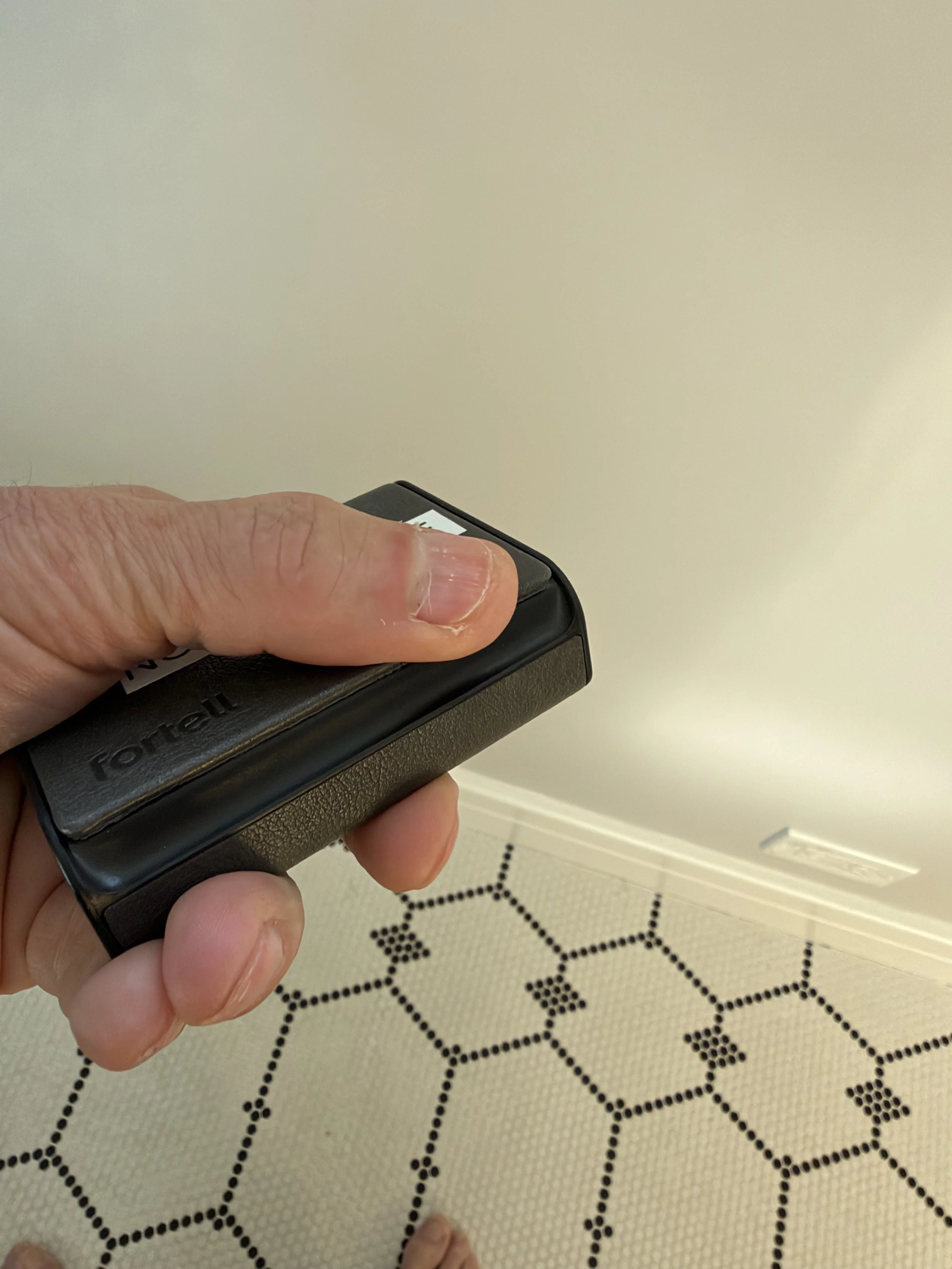
I preferred Fortell's flatter charging case.
The Phonak case is bulkier than I'd like.
However, the fit and comfort of the actual hearing aids mattered more to me than the size of the charging case.
Tinnitus: An Unexpected Benefit
One unexpected benefit of wearing hearing aids has been a reduction in my awareness of tinnitus.
I've experienced cricket-like and summer-insect sounds in my ears for years.
When wearing my Phonaks throughout the day, I sometimes barely notice the tinnitus, even in relatively quiet surroundings.
When I remove the hearing aids at night, the tinnitus becomes noticeable again.
I understand that this isn't necessarily unique to Phonak.
Many hearing aids can help make tinnitus less noticeable by restoring access to everyday sounds.
I didn't specifically compare tinnitus relief between the Phonaks and Fortells, so I can't say one performed better than the other.
Nevertheless, experiencing less noticeable tinnitus has been a meaningful benefit of wearing hearing aids again.
Apps and Personalization
The Phonak app allows me to adjust the sound and save customized listening programs.
I've experimented with settings for everyday listening, outdoor walks, and music.
I appreciate having that flexibility.
The Fortell app offered AI, Conventional, and Music modes, but I often found myself switching between them, trying to find a setting that worked well.
I also found some of its phone-call controls less intuitive.
Neither app was perfect, but I preferred the Phonak experience.
Appearance, Colors, and Design
Appearance is something I consider when choosing a device I'll wear every day.
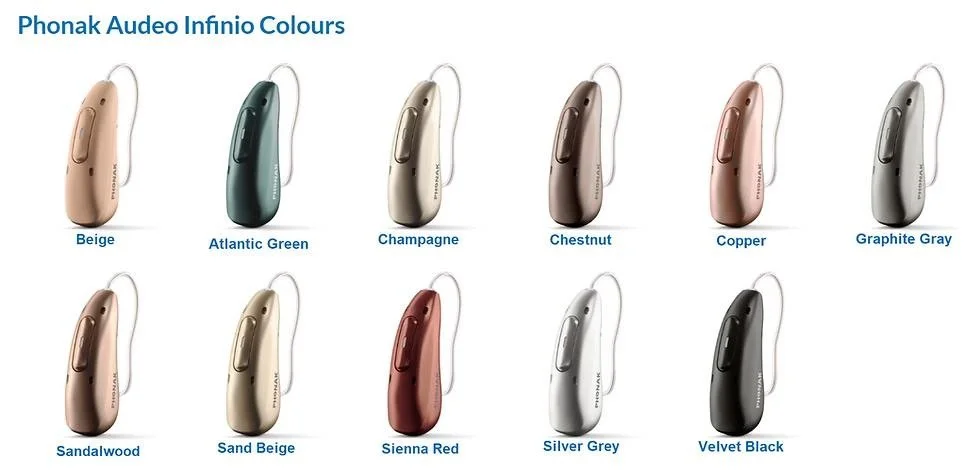
One thing I appreciate about Phonak is the variety of colors offered across the Audéo Infinio range.
Phonak originally advertised as many as ten colors: Sand Beige, Sandalwood, Chestnut, Champagne, Silver Gray, Graphite Gray, Velvet Black, Copper, Sienna Red, and Atlantic Green.
However, not all of those colors appear to be currently available. Phonak's more recent U.S. product information displays a smaller selection of seven standard colors, and availability may differ depending on the specific model.
My current Phonaks are Sand Beige, but I'm interested in changing them to a warmer, earthier color.
I'm particularly interested in Sandalwood and Sienna Red.
I'd love to see Sienna Red in person, although I need to confirm with Kathleen whether it's available for my exact hearing aids.
Atlantic Green also caught my attention when I learned it had originally been advertised, but it doesn't appear among the current standard color choices.
I appreciate having several options, even if some of the originally advertised colors aren't available to order.
Fortell's Color Options
The Fortell hearing aids I tested were a very light silver, almost white.
When I originally researched Fortell, its website displayed four colors: Silver, Champagne, Bronze, and Black.
However, the Champagne, Bronze, and Black options were subsequently removed from the website.
My understanding is that those additional colors aren't currently being manufactured because the product is still so new.
That left the pale Silver as the only available option during my demonstration.
I would have appreciated more choices.
The Fortells were also physically larger, which was another consideration when wearing them with glasses.
Color and appearance weren't the deciding factors, but they contributed to my overall preference.
Price, Warranty, and Value
Premium hearing aids are a significant investment.
I purchased my Phonak Audéo Infinio Sphere I90 hearing aids through the AARP Hearing Care by Soundly program at Soundly.com for $3,498 per pair.
My package included the rechargeable hearing aids, charging equipment, evaluation, orientation, a four-year warranty, and a 60-day trial with a full refund available during the trial period.
The Fortells were quoted at approximately $6,800 per pair, a difference of $3,302.
Fortell offered me a special two-week demonstration for $200 because I live relatively close to its Boston office.
This was a limited local offer for people living near Boston, not a nationwide trial available to customers traveling from out of state.
However, if I wanted to continue trying the Fortells after those two weeks, I would have had to purchase them for approximately $6,800.
That purchase would begin Fortell's 100-day trial period. If I ultimately decided to return them during that period, $300 would be retained.
So, unlike my initial $200 demonstration, continuing the trial would require a substantial upfront investment.
Fortell's purchase package also included five years of audiology service.
I appreciated the opportunity to try them without committing to that purchase.
The price difference was meaningful, but it wasn't the only reason for my decision.
Even if both hearing aids had cost the same amount, I would still have chosen the Phonaks based on my listening experience and comfort.
Returning the Fortell Hearing Aids
On November 20, I returned the Fortell hearing aids to their office on Newbury Street in Boston.
The process couldn't have been easier.
As I arrived, I happened to run into Corinne, who was accompanying another patient for a real-world hearing test at a nearby coffee shop.
We said hello, and I appreciated the nice email she'd sent me.
I then went up to Fortell's third-floor office, handed the hearing aids to the receptionist, and that was it.
No complications, no pressure, and no uncomfortable conversations.
Just a simple, pleasant return experience.
I appreciated how accommodating and professional everyone at Fortell had been throughout the demonstration.
Although the hearing aids weren't the right match for me, the customer experience was excellent.
What Fortell Did Well
I want to be fair to Fortell.
I appreciated being offered the special local demonstration.
Corinne performed real-ear measurements, listened to my feedback, and was willing to make adjustments.
The Newbury Street office was beautiful, and meeting Cole on opening day was a memorable experience.
I preferred the flatter charging case and appreciated having several listening programs to experiment with.
The return process was also straightforward and pleasant.
My friend Paul's positive experience is a reminder that Fortell may be an excellent choice for someone with different hearing needs and preferences.
I also recognize that a longer adaptation period might have changed my impressions.
But during my demonstration, the sound never became consistently comfortable for me.
What I'd Still Like to Improve with Phonak
Although I'm very happy with my decision, there are still a few things I'd like to work on.
I'd like to improve speech understanding in crowded restaurants and other noisy environments.
I'd also like Kathlryn to fine-tune the dedicated Music program and Spheric speech-in-noise settings.
I'm curious about gradually increasing the amplification over time as I continue adapting to wearing hearing aids.
I'd appreciate more streaming equalizer control and a smaller charging case.
And I'm continuing to work on finding the most comfortable dome fit.
These aren't reasons to reconsider my decision. They're simply areas where I think the experience could become even better.
Appreciating the Opportunity to Compare Both
One thing I'm especially grateful for is having had the opportunity to wear and compare two premium hearing aids during the same period.
Not everyone has that opportunity.
Being able to switch between them in familiar situations gave me a much better understanding of their differences.
I could compare them during conversations, watching television, listening to music, driving, attending trivia night, and spending time with friends.
Rather than relying on memories of how one hearing aid sounded weeks earlier, I could experience the differences firsthand.
I'm grateful to Kathryn at Beverly/Cape Ann Audiology and Corinne at Fortell for their help and willingness to make adjustments.
I'm also grateful that Fortell offered me the special demonstration in Boston.
Having both pairs available helped me make a more informed decision based on my own hearing and preferences.
My Final Decision
After testing both hearing aids in everyday situations, I'm keeping the Phonak Audéo Infinio Sphere I90s and have returned the Fortells.
The Phonaks provided the listening experience I preferred, along with greater comfort, more reliable Bluetooth connectivity, convenient phone controls, and more color choices.
I also appreciated the significant savings.
The Fortells offered sophisticated technology and excellent customer service, but they weren't the right match for my ears.
I recognize that with more time, I might have become accustomed to their sound.
However, I didn't feel it made sense to make a substantial additional investment when I already had hearing aids I was enjoying.
I want to emphasize that my decision isn't a criticism of the people at Fortell.
Corinne was helpful and accommodating, and I thoroughly enjoyed visiting the new Boston office and meeting Cole.
The return process was easy, and I appreciated the professional treatment I received throughout the demonstration.
I also know from Paul's experience that the Fortells can be a very good choice for someone else.
Hearing Is Personal
Everyone has a different degree and pattern of hearing loss, different listening needs, and different preferences for how things should sound.
What works beautifully for one person might not be the best choice for someone else.
My friend Paul is happy with his Fortells, while I prefer my Phonaks.
Neither of us is necessarily right or wrong. We're simply hearing the world differently.
That's why I think it's important to try hearing aids for yourself, have them professionally fitted and adjusted, and give yourself time to adapt before making a decision.
This isn't a review declaring Phonak better than Fortell. It's an explanation of why Phonak is better for me.
After decades of hearing loss, I'm still rediscovering sounds and learning what natural hearing means to me.
I've also learned that louder doesn't necessarily mean better.
I don't need to hear every sound at maximum volume. I want to hear the world in a way that feels balanced, comfortable, and natural.
And while I've made my choice, my hearing journey isn't finished.
I'm looking forward to continuing to work with Kathleen, making gradual adjustments, and seeing how much further I can improve my hearing experience.
The Phonaks aren't perfect, but they've brought me closer to that goal than any hearing aids I've tried.
My choice: Phonak Audéo Infinio Sphere I90.
For the sound. For the comfort. For the reliable connectivity. For the color choices. And yes, for the substantial savings.
For my ears, my lifestyle, and my budget, Phonak was the better choice.
This review reflects my personal experience during October and November 2026. Hearing aid performance varies depending on individual hearing loss, fitting, and preferences. I purchased the Phonaks through AARP Hearing Care by Soundly and participated in a paid Fortell demonstration. This is not a sponsored review.